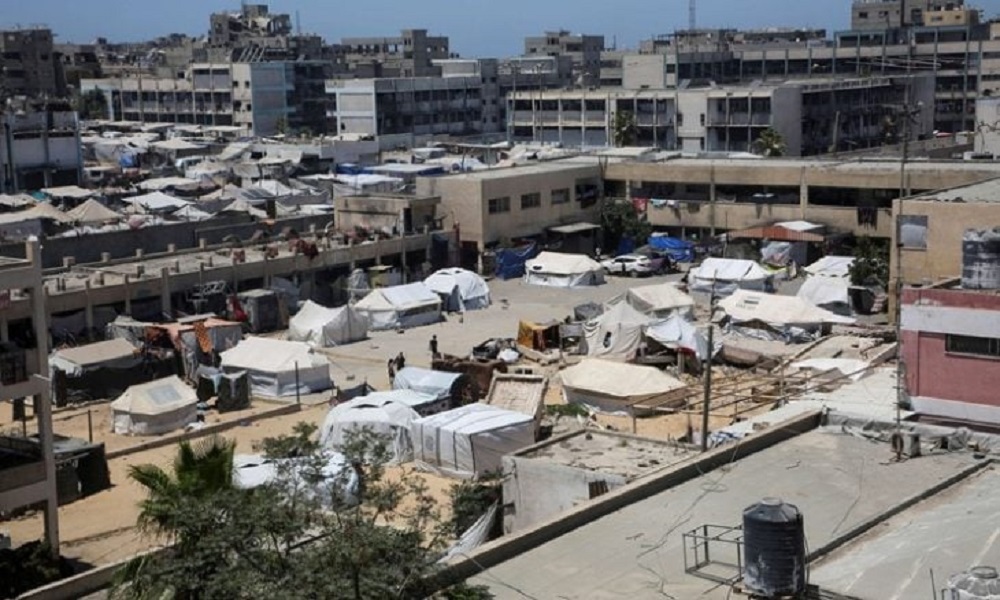
Watan-Journalistic sources revealed today that Israeli Prime Minister Benjamin Netanyahu, not Defense Minister Yisrael Katz, was the one who ordered—before departing for Washington—the drafting of a plan to build what is being called a “humanitarian city.” These sources cited military leaders who reportedly stated that the Israeli army lacks the tools to implement such a plan.
The Israeli daily Haaretz fiercely criticized the project in its Thursday editorial, describing the plan as a “criminal transfer” of Palestinians. The paper addressed U.S. President Donald Trump directly, saying:“When the person nominating you for the Nobel Peace Prize promotes the creation of a detention camp for all Gaza residents—who can only leave if they ‘choose’ to emigrate—it’s unclear whether he’s praising you or sabotaging your candidacy.”
In an editorial titled “This Is Called a Concentration Camp,” Haaretz argued that Netanyahu’s endorsement of Katz’s “criminal” plan to build a “humanitarian city” over the ruins of Rafah, where all Gaza residents would be relocated, represents a historic and moral collapse for both the State of Israel and the Jewish people.“No matter how Israel tries to rebrand this plan with euphemisms, it remains a detention camp,” the paper asserted.
“Apparently, Israel believes that labeling something ‘humanitarian’ grants it legitimacy—just as it uses the phrase ‘the most moral army in the world,’ which is now entirely detached from the actions of Israeli soldiers. Now, they are trying to depict a deportation camp as ‘the most moral detention camp in the world.’”

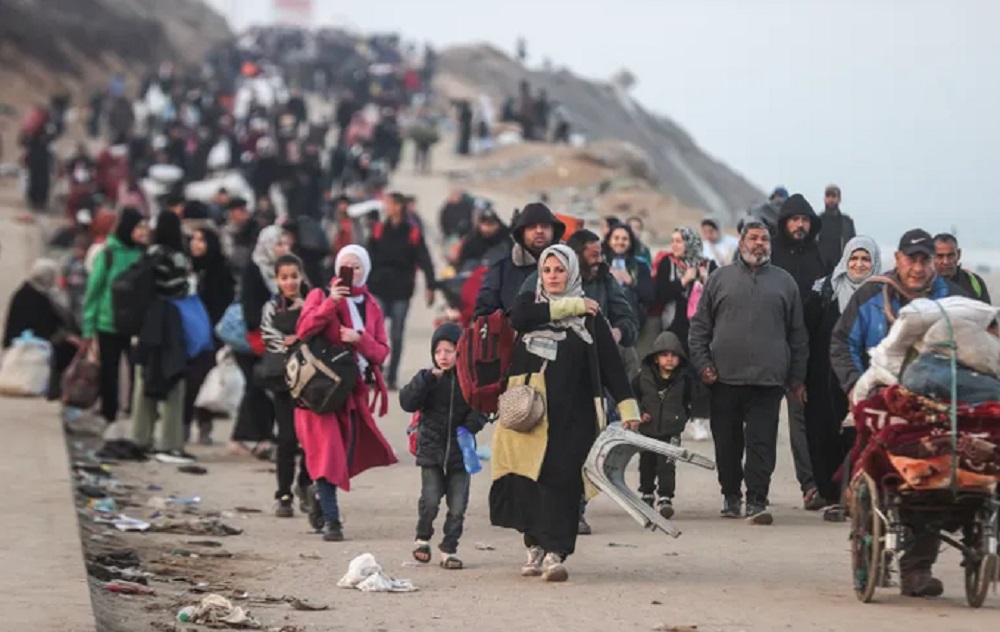
Haaretz cited an Israeli source stating that “the core of the plan is to relocate all Gaza civilians southward into a massive tent city in Rafah, equipped with hospitals and plentiful food supplies.”
The editorial further warned:“In Israel, historical comparisons are taboo. When dark times are evoked, something is always lost in translation. As long as the camp is not a stop on the way to the gas chambers, it’s easy to dismiss comparisons and normalize almost any injustice. As long as it’s not the Holocaust, everything seems permissible. Thus, the historical comparison—meant to sound the alarm—becomes a tool to silence criticism and normalize oppression.”
The paper concluded that the Gaza war has no clear military or political objectives, except for one horrifying possibility: a second Nakba, or the “voluntary” deportation of the entire Palestinian population. Haaretz demanded an immediate end to the war. “Yesterday, 26 people were killed in Gaza. A day earlier, no fewer than 80—mostly displaced persons including women and children—were killed.”
Unlike most Hebrew media outlets, Haaretz covered Israeli atrocities in Gaza, noting that the Israeli army bombed densely populated areas, including schoolyards, shelters, tents, and aid distribution centers.
The Red Cross warned of the collapse of Gaza’s healthcare system, confirming that most of the victims were trying to get food, including children, teenagers, and the elderly. According to the Red Cross,“The scale and frequency of these attacks are unprecedented.”
The editorial reaffirmed that the war in Gaza serves no military or political purpose and is leading only to disguised ethnic cleansing.
Haaretz ended its editorial with the following demands:“This war must end immediately. The hostages must be retrieved. The army must withdraw from Gaza. Control must be transferred to the Palestinian Authority within a regional and international framework. It is forbidden—whether by consent, silence, or indifference—to participate in plans that threaten Israel’s national security.”

In a related op-ed, Haaretz journalist Gideon Levy echoed the editorial’s warnings and compared the “humanitarian city” to Nazi practices.
Levy wrote:“If Mordechai Anielewicz, commander of the Jewish resistance in the Warsaw Ghetto, were asked about this plan, he would die of shame. He wouldn’t believe that anyone, 80 years after the Holocaust, would dare to propose such a monstrous idea.”
-

-
-

-

-

-