Israel’s Aid Distribution Project in Gaza Sparks Uproar Over Militarization, Surveillance, and Foreign Involvement
Hundreds of armed Americans to guard new aid centers as Israel tightens control over humanitarian relief—critics say the plan bypasses the UN, exploits hunger, and aims to collect intelligence on Palestinians.
Watan News
Gaza aid distribution
Watan-Following delays in launching four newly established aid distribution points in Gaza, Israel’s Yedioth Ahronoth detailed on Sunday how this controversial project will soon go into operation. The newspaper revealed that hundreds of armed American contractors will guard the centers, while Israeli forces monitor movements via aerial surveillance, with the system designed to limit Hamas’s ability to control aid.
According to the report, the distribution centers are located between the Netzarim Corridor, which divides northern and southern Gaza, and the northern section of the Morag Corridor. These hubs aim to serve approximately one million displaced Palestinians now sheltering in the al-Mawasi area in southern Gaza. The Israeli army, under government direction, is also planning additional aid points in areas it deems “cleansed of terror,” such as Rafah, which has been razed to the ground.
Yedioth described the distribution model as “individualized”, similar to how food aid is given to poor Israeli families before Jewish holidays. Palestinians will receive pre-approved food baskets after passing through security checks, a sharp departure from the UN-led bulk aid system. This previous model involved distributing goods to local NGOs and vendors—some of which were then sold, sometimes under pressure from criminal groups operating openly with Israeli awareness.
The food baskets, according to Israeli planners, are tailored to caloric needs and include flour, oil, sugar, grains, protein portions, baby food, and allergen-specific items like gluten-free products.
Each aid center is expected to serve around 300,000 people, operating 24/7 in three shifts, staffed by non-UN-affiliated NGOs. Dozens of trucks will enter daily, while the sites—surrounded by high dirt berms—will be protected by armed U.S. contractors and monitored by Israeli military intelligence.
The newspaper added that American contractors trained with the Israeli military in recent days to prepare for possible scenarios, including militant attacks or rocket strikes.
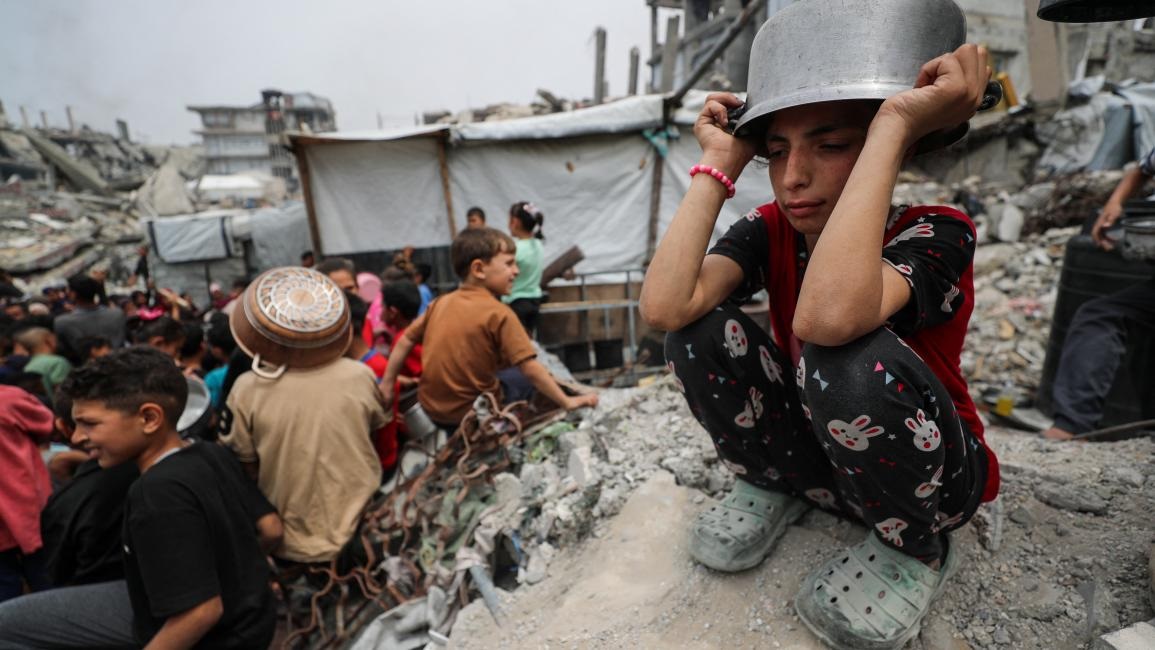
Gaza humanitarian crisis
The Real Motive: Control and Data Collection
Although Israel claims its aim is to strip Hamas of its civil governance, critics argue this is a larger strategic move to use food access as leverage, imposing security screening in exchange for basic rights and gathering personal data on civilians. Some say the policy effectively weaponizes hunger to drive forced displacement.
A separate Haaretz report revealed that Israel’s plan sidestepped the United Nations and violates international law, which mandates that aid reach civilians in conflict zones without conditional access.
This aid strategy, according to Haaretz, was conceived early in the war, in October 2023, when a special Israeli committee called the “Mikveh Israel Forum” was formed. This group included reserve officers, strategic advisors, and businessmen, including figures like Yotam Hacohen (former assistant to the Israeli civil coordination unit), Roman Gofman (Netanyahu’s military advisor), and Israeli-American investor Michael Eisenberg.
Their proposal: bypass Hamas not by dissolving its government, but by directly managing civilians through aid—thus, controlling Palestinian life through their food supply.
Despite initial pushback within the committee against taking direct responsibility for Palestinian needs, the solution became privatization: involve foreign security companies to manage the aid infrastructure.
Shady Contracts and Foreign Firms
After Netanyahu dismissed Defense Minister Yoav Gallant in late 2023, he reactivated the aid forum, transferring oversight to it and inviting private companies, such as Orbis, which began conducting field preparations at the Netzarim checkpoint without a formal bidding process.
Documents show that Israel’s Ministry of Defense transferred millions of shekels to Orbis despite its lack of official contract or equipment. Its personnel even had to buy uniforms and gear inside Israel upon arrival. Notably, some Egyptian team members in Gaza were not cleared by Israeli security, prompting criticism from inside the Shin Bet.
Another firm, Safe Reach Solutions (SRS), led by former CIA officer Philip Reilly, has been active since early 2024. Reilly, who once trained Contra rebels in Nicaragua and ran the CIA station in Kabul, was involved in other U.S. military operations. His company, and its spinoffs GHF (Gaza Humanitarian Fund) and SRS USA, were quietly funneled millions of shekels through intermediaries.
According to Haaretz, these firms operated during the brief January ceasefire and tested security protocols at Gaza checkpoints. Though Israel publicly denies involvement, its ambassador in Washington, Yehiel Leiter, recently admitted:
“Israel and the U.S. jointly established the GHF, including special forces veterans who participated in humanitarian missions in Haiti. These are the same people now distributing aid in Gaza.”
famine deepens in Gaza,
Conclusion
Critics argue that the Israeli-controlled aid system is a militarized apparatus cloaked in humanitarian language, aimed at undermining Palestinian sovereignty, weaponizing food, and extending intelligence operations under the guise of relief.
The project has not only displaced UN agencies but introduced foreign military contractors into the heart of Gaza’s humanitarian operations—raising urgent legal, moral, and geopolitical questions.