
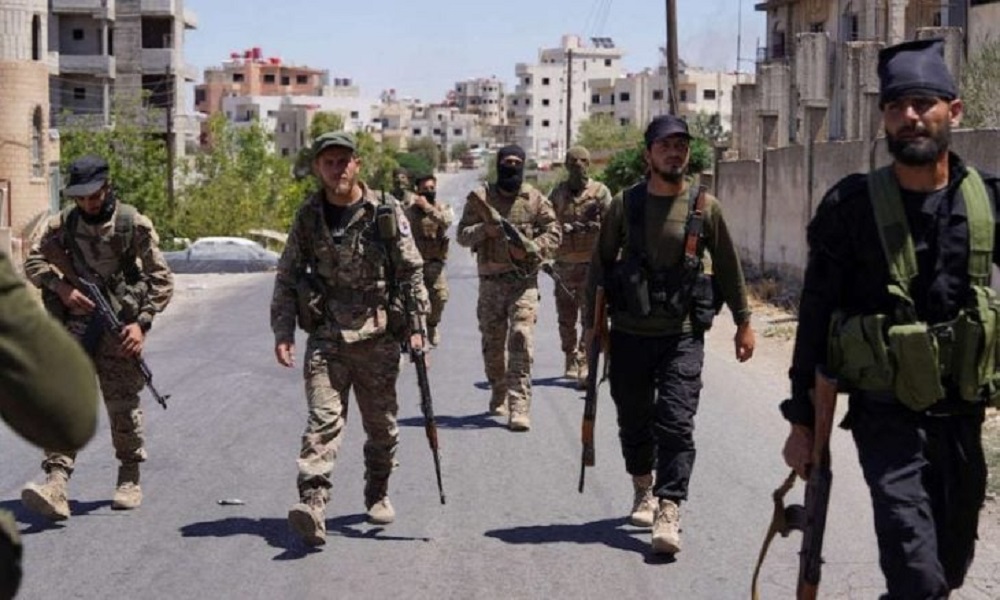
Watan-Syrian authorities have withdrawn their forces from Suwayda province, where a photographer from AFP observed bodies lying in the streets of the city center on Thursday. The move coincided with a televised statement from interim President Ahmad al-Shara, who said he wanted to avoid a “wide-scale war” with Israel, which has threatened further escalation.
The withdrawal of government forces from the predominantly Druze province undermines the interim government’s efforts to assert authority across all Syrian territory — over seven months after the fall of the previous regime — and raises fresh questions about its ability to manage minorities, amid recurring sectarian violence affecting multiple communities.
Suwayda city, which has witnessed bloody clashes in recent days, including looting and attacks on homes and shops, now resembles a disaster zone:
-
The main hospital is out of service
-
Bodies are piling up inside
-
Water, electricity, and telecommunications have been cut off for days
In the city center, an AFP photographer counted at least 15 bodies on Thursday morning. It was unclear if they were civilians or local fighters. Some corpses were bloated, suggesting they had been dead for several days.
Clashes, Israeli Strikes, and Rising Toll
According to the UK-based Syrian Observatory for Human Rights, the four days of sectarian violence, during which Israel launched several air raids, resulted in over 370 deaths.
The Syrian government completed its withdrawal from Suwayda overnight Wednesday into Thursday.
SOHR Director Rami Abdel Rahman told AFP:“Syrian authorities withdrew all military forces from the city and the entire province of Suwayda, leaving control to local Druze fighters.”
Government troops positioned on the outskirts of the province said they had received orders to retreat before midnight, and completed their withdrawal by dawn.
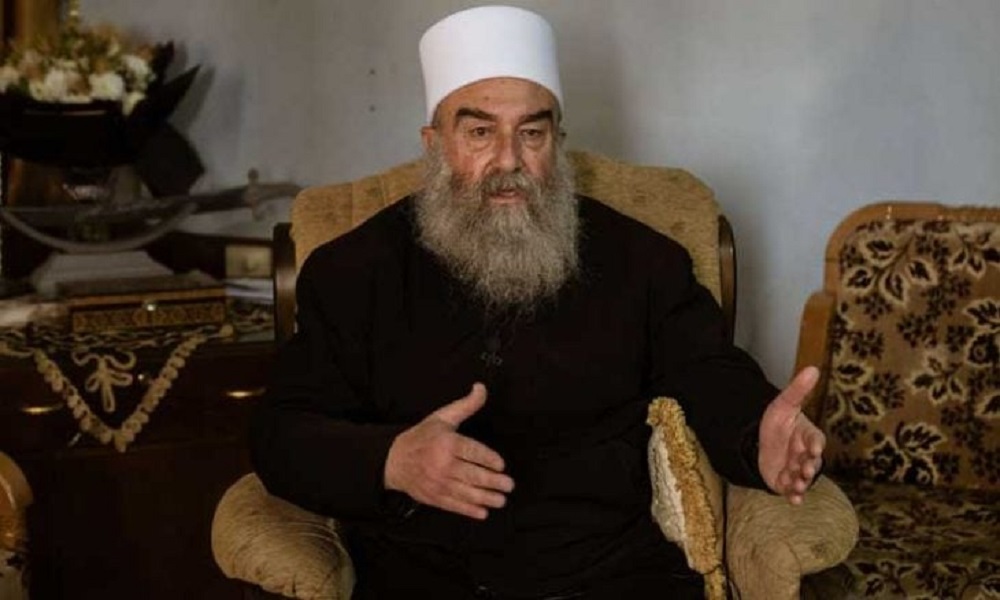
This occurred just hours after an announced ceasefire agreement between the Syrian Interior Ministry and Sheikh Yusuf al-Jarbou’, one of the three main Druze spiritual authorities in Suwayda.
The deal stipulated an immediate cessation of hostilities and the formation of a monitoring committee comprising Syrian state officials and Druze elders.
However, Abdel Rahman said the government’s withdrawal was part of a secret Syrian-Israeli security agreement, brokered by the United States, following Israeli pressure on the interim authority to withdraw from Suwayda.
In his early morning televised address, President al-Shara said local factions and Druze elders would take responsibility for security in Suwayda, claiming the aim was to prevent Syria from sliding into another large-scale war.
He declared:“We were faced with two choices: an open war with the Israeli entity — risking the lives of our Druze citizens and national stability — or allowing Druze leaders and notables to regain their composure and prioritize national interests.”
His remarks came after intense Israeli airstrikes that damaged part of Syria’s General Staff building in Damascus, killing three people, according to state media.
Israel also struck targets near the presidential palace in Damascus, in the south of the capital, and in Suwayda.
Sectarian Violence and American Mediation
Clashes erupted Sunday between Druze fighters and Sunni Bedouin tribesmen, reportedly triggered by the kidnapping of a Druze vegetable merchant, followed by reprisal abductions.
While the Syrian army said it had intervened to separate the warring factions, witnesses, Druze factions, and the Observatory accused government troops of siding with the Bedouins.
Despite a Tuesday announcement of a truce, fighting persisted until the official ceasefire on Wednesday night.
The violence involved killings, arson, looting, and other abuses, according to locals, activists, and the SOHR.
President al-Shara praised the “effective intervention of American, Arab, and Turkish mediators”, crediting them with saving the region from an unknown fate.
The U.S., which supports Israel and backs the Syrian interim government, announced Wednesday night that it had helped broker the ceasefire.


U.S. Secretary of State Marco Rubio wrote on X:“We have agreed on specific steps that will end tonight’s disturbing and horrifying situation. We expect all parties to honor their commitments.”
Earlier, U.S. State Department spokesperson Tammy Bruce had called on the Syrian government to withdraw from the conflict zone in the south to de-escalate tensions with Israel.
“Field Executions” and Promises of Justice
The Syrian Observatory documented 27 civilians killed in field executions carried out by government forces.
President al-Shara pledged:“Those who wronged and harmed our Druze brothers will be held accountable. They are under the protection of the state.”
He had made a similar vow following earlier violence in the coastal region, where some 1,700 civilians — mostly from the Alawite minority (to which the Assad family belongs) — were killed by security forces and allied militias, according to the SOHR.
Druze in Syria and Golan Border Tensions
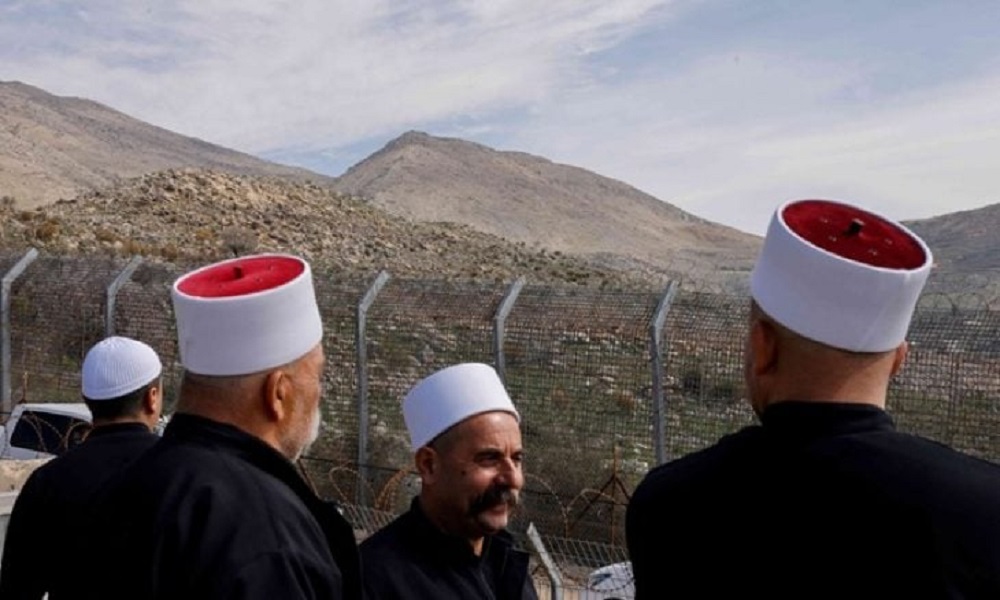
Syria’s Druze population is estimated at around 700,000, most of whom live in Suwayda province. Large Druze communities also exist in Lebanon and Israel.
On Thursday morning, dozens gathered at the Syrian-Israeli border in Majdal Shams, a Druze town in the Israeli-occupied Golan Heights, following chaotic scenes Wednesday, when hundreds of Druze tried to cross the border in both directions.
Young men were seen Thursday walking near the border waving five-colored Druze flags.
A man from Hadar village in Syria, who had crossed with his son to meet relatives in Majdal Shams, told AFP:“We didn’t sleep all night.”
-
-
-
-
-

-

