Under Fire: Amnesty International Report Reveals Israeli Attack on Journalists in Lebanon
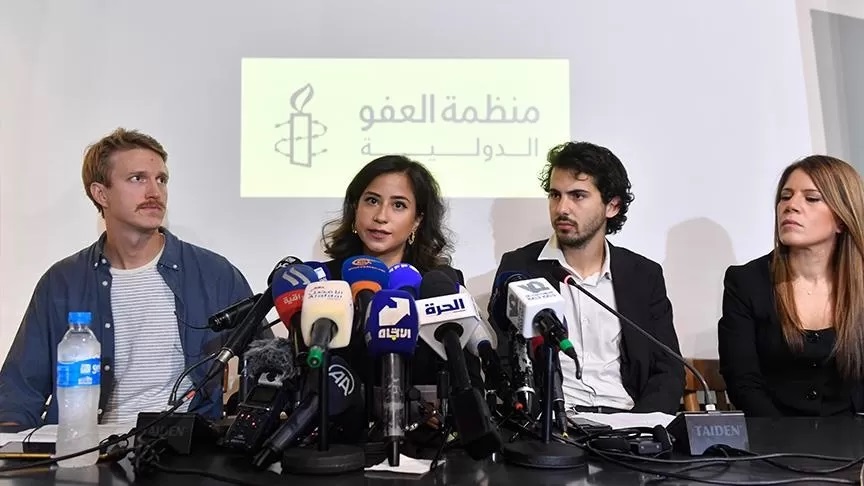
Watan-The International Amnesty Organization has issued a report regarding an Israeli attack that targeted several journalists in Lebanon, as part of the ongoing escalation associated with the war on Gaza.
The organization’s investigation revealed horrifying evidence indicating a brutal Israeli attack on a group of seven journalists in southern Lebanon on October 13, resulting in the death of the journalist from Reuters, Essam Abdullah, and the injury of six others.
يكشف تحقيق جديد أجرته منظمة العفو الدولية عن أدلة مروعة تشير إلى هجوم إسرائيلي وحشي على مجموعة من 7 صحفيين في جنوب لبنان يوم 13 أكتوبر، مما أدى إلى مقتل صحفي رويترز عصام عبد الله وإصابة 6 آخرين. نرجح أن الغارة كانت هجومًا مباشرًا على مدنيين ويجب التحقيق فيها باعتبارها جريمة حرب. pic.twitter.com/O4lIiGuY0C
— منظمة العفو الدولية (@AmnestyAR) December 7, 2023
In the report, Amnesty International stated that it is likely the airstrike was a direct attack on civilians and should be investigated as a war crime.
Amnesty International verified the authenticity of over 100 video clips and images, analyzed weapon fragments taken from the site, and conducted interviews with nine witnesses.
The results indicate that it was clear the group comprised journalists, and the Israeli army knew or should have known they were civilians. Nevertheless, they were attacked with two strikes separated by 37 seconds.
The seven journalists were reporting from southern Lebanon, wearing helmets and bulletproof vests labeled “Press.” Since 5 p.m. on October 13, near the town of Alma ash-Sha’b in the district of Tyre, approximately an hour before the attack, they had not moved from the same exposed location, remaining within sight of Israeli forces on the other side of the border. One of the vehicles they used had a “TV” (Television) sign on its engine cover.
In footage recorded by the journalists, an Israeli Apache helicopter and likely an Israeli drone could be seen and heard hovering above them for over 40 minutes before the first strike. The Israeli forces had observation towers, ground elements on the other side of the border, and aircraft closely monitoring the area. All of this should have provided sufficient information to the Israeli forces that these individuals were journalists and civilians, not military targets, as confirmed by the organization.
There was no presence of fighters
The International Amnesty Organization found no indication of the presence of any fighters or military targets at the site where the strikes occurred. This strongly suggests that these strikes were direct attacks on civilians.
Based on a review of video clips and images captured from the incident site – including the analysis of weapon fragments at the site, the injuries sustained by the victims, and an examination of the two impact zones on a stone wall beside the road and in a nearby crater – Amnesty International identified that the first strike, which killed Essam Abdullah and caused severe injury to video journalist Christina Assi of Agence France-Presse, resulted from a 120mm artillery shell fired from the hills separating Naqoura and Jaroudi in Israel.
After only 37 seconds, the group was subjected to a second strike, this time with a different weapon, likely a small guided missile, causing a fire in the Jazeera team’s vehicle.
Amnesty International interviewed nine witnesses: three of the journalists who were injured in the strikes and six others who were near the attack site, and they heard or witnessed the strikes and their aftermath.
The attack on journalists
On October 13th, journalists gathered at a site near Alma ash-Sha’b in southern Lebanon to cover the ongoing clashes between Israeli forces and Hezbollah.
Exactly 1 hour and 23 minutes before the first strike on the journalists, everyone aimed their cameras southwest towards the Haniyeh point, capturing footage of an Israeli military site on the border with Lebanon.
The scenes captured by three different cameras revealed the Israeli military infrastructure, including an observation tower, antenna, and a Merkava tank firing towards the Dabsheh area in Lebanon.
At precisely 6:02 p.m., an Israeli tank positioned east of the journalists fired the first shell, killing Essam Abdullah, who was sitting on a stone ledge, and severely injuring Christina Assi. Another strike hit the ground near Jazeera’s car 37 seconds later, using a different weapon, causing it to catch fire.
Eli Barkha described the moment: “I was looking at Essam when I heard the [first] explosion. I saw Essam’s body flying with a glow and heat behind him. I quickly climbed the hill, and heard Christina screaming that she couldn’t feel her legs. I rushed to where she was, and saw Dylan searching for a tourniquet for her wounds.”
Dylan Collins vividly described the distressing scene as he hurried to assist his injured colleague Christina, discovering that her leg had been shattered by the first explosion. He said, “As soon as I turned around, I heard Christina say ‘Oh God,’ so I asked her, ‘Are you okay?’ and I rushed towards her and saw that her legs were shattered up to the knee.”
The second explosion occurred while he was attempting to secure tourniquets around her legs. He said, “When the second explosion happened, I was shocked and felt dizzy, but in my blurred memory, I remember Essam’s leg falling in front of me. I looked up and saw Carmen next to the car, her face blackened, walking unsteadily. Her entire back was covered in shrapnel.”
The video clips and images depict the aftermath of the attack, corroborated by the organization, showing three injured journalists – Christina Assi, Eli Barkha, and Carmen Gokhdar – and the body of Essam Abdullah alongside Jazeera’s burnt car.
Official reports on the journalists’ conditions:
The organization reviewed the report issued on October 13th by the Forensic Medicine and Criminal Evidence Department at the Lebanese Ministry of Justice after examining the body of Essam Abdullah. The report indicated that his body suffered severe wounds and burns.
Christina Assi lost one of her legs and was still in the hospital at the time of this press release. Dylan Collins sustained injuries from shrapnel on his face, arms, and back. Maher Nazih suffered injuries to his arms and other shrapnel-related wounds, and Thaer Al-Sudani was injured by shrapnel on the entire left side of his body.
Carmen Gokhdar also sustained injuries from shrapnel, particularly in the lower half of her body, while Eli Barkha suffered severe injuries to his arms and a shattered shoulder.
Journalists’ Location
Journalists gathered on October 13th next to a road passing over a hill near Alma ash-Sha’b in Tyre, about one kilometer from the Israeli border.
The journalists had gathered at this location to capture footage of the ongoing clashes in Hanita, northern Israel, following suspicions of an attempted infiltration by armed Palestinian groups and an explosion at the border fence earlier that day, causing “minor damage,” according to the Israeli army.
Shortly afterward, the Israeli army announced that it ruled out an infiltration attempt but reported gunfire directed at several military posts along the Lebanese border. The Israeli army responded with artillery fire toward Hezbollah’s infrastructure, stating that the artillery targeted the source of the gunfire.
The National News Agency in Lebanon reported an exchange of gunfire between Hezbollah and Israel in the border area between the towns of Alma ash-Sha’b and Adaisseh.
Evidence from the journalists’ lenses
The footage captured by the journalists who were attacked, as reviewed by Amnesty International, indicates that they were documenting the border clashes between the Israeli forces, Hezbollah, and other armed groups in at least five different locations, likely in the towns of Naqoura, Admit, Hanita, and their surroundings in Israel, at least 1.5 kilometers away from their location.
The video clips, verified by Amnesty International, show that the media crews were on a hill located on a road near a house that provides a wide view of the valley forming the border between Lebanon and Israel. This position put the journalists in a clear line of sight for a group of Israeli military sites, including Naqoura, Jardah, and Hanita.
Journalists from Agence France-Presse, Al Jazeera, the Lebanese Broadcasting Corporation, and Al Jadeed TV informed Amnesty International that they intentionally chose this location because it is situated on a hill, allowing them to film and report on the ongoing clashes in Hanita on another hill separated from them by a valley.
The journalists told Amnesty International that following what appeared to be a battle of gunfire on the Israeli side of the border, the Israeli army began a sweep to ensure that the suspected infiltration threat had been eliminated.
The video and photo evidence, verified by Amnesty International, shows that the seven journalists were wearing body armor labeled with the word “Press,” and the blue car belonging to the Reuters team was marked with the word “Television” and a yellow strip on its engine cover.
Eli Barakia described the precautionary measures taken by the journalists, saying, “Our car was white, and we deliberately kept all its doors open to declare that we were journalists standing on an entirely open hill with no military presence, trees, people, just a few houses, and white sand. As journalists, we don’t choose suspicious locations; we choose completely exposed sites.”
Carmen Gokhdar added, “We were seven reporters wearing press vests and helmets, with three media cars and several cameras on tripods. It was impossible for anyone to mistake us.”