Israel Hails U.S. Strike on Iran’s Nuclear Sites as “Historic Turning Point”
Tel Aviv celebrates U.S. bombing of Iran’s Fordow facility as part of Operation Rising Lion, amid Israeli claims of unprecedented missile damage from Iranian retaliation and concerns over future nuclear escalation.

Watan-Israeli official sources stated that the latest Iranian missile barrage differed from previous ones due to the use of an advanced missile known as “Kheibar”, which hit several locations in the greater Tel Aviv and Haifa areas. The strike caused significant destruction and injured around 30 Israelis, most of whom suffered minor to moderate injuries.
The same officials added that the missile salvo on Sunday morning included 30 missiles, and air raid sirens were activated across the country. However, in Haifa, the missiles struck before the sirens sounded. They suspect that the missile which caused severe damage to an entire neighborhood was actually an Israeli interceptor that failed to intercept the Iranian missile and fell inside the city, causing massive destruction. This marks the fourth such incident in Haifa, a city that houses an industrial zone and strategic facilities.


Israel’s Home Front Command noted that the Iranian barrage was both intense and precise, but the public’s adherence to safety protocols—staying inside shelters and secure rooms—saved many lives, even in collapsed apartment buildings. Reinforced shelters remained intact and prevented higher casualties.
Israeli Joy Over U.S. Involvement
According to Israeli public radio, security sources said that Israel could not have destroyed Iran’s Fordow facility alone. They added that Israel had known for a long time that President Trump would eventually launch the strike, which took place early Sunday. The report noted that the U.S. administration intentionally carried out the strike while U.S. markets were closed to avoid a negative impact on stock prices and financial investments.
The same sources stated that Israel had completed its list of targets inside Iran, particularly the nuclear facilities, and was waiting for U.S. intervention, as only the U.S. military has the capability to destroy the deeply buried nuclear site at Fordow.
This kind of reliance on foreign support during wartime is not new for Israel, as it has previously requested similar support in past wars, most notably in 1973. However, this practice goes against Israel’s traditional security doctrine, as outlined by David Ben-Gurion in 1948, which emphasized self-reliance in matters of national defense.

Iran’s Pragmatic Response
In contrast, a high-ranking Iranian source stated that the contents of the targeted nuclear facilities were emptied beforehand, while other Iranian entities claimed that the majority of Iran’s enriched uranium is stored in secure locations.
In a statement, the Iranian Foreign Ministry said that Iran reserves the right to respond to the American aggression, accusing Washington of launching a war in the midst of ongoing negotiations. The statement added that Iran will turn to international institutions, warning that silence in the face of such blatant aggression exposes the world to unprecedented and ongoing danger.
Foreign Minister Abbas Araghchi stated that the United States had gravely violated the International Non-Proliferation Treaty (NPT) and reiterated that Iran’s nuclear facilities serve peaceful purposes.
Meanwhile, Iranian state radio issued a chilling warning, declaring that “every American citizen from now on is a legitimate target.” The Houthis in Yemen echoed this threat, saying that a response to the United States was just a matter of time.
Despite these warnings, Araghchi spoke in cautious terms, likely reflecting Iran’s intention to retaliate against Israel without escalating into direct conflict with the United States. Given Iran’s limited missile stockpile, it may not be prepared for a prolonged war of attrition.
Moreover, Iran’s strategic calculations prioritize the survival of the regime, especially since a full-scale war could jeopardize the entire nuclear program—whether or not the facilities themselves suffer major damage. Iran’s possession of enriched uranium gives it a continued opportunity to achieve its long-standing goal of acquiring nuclear power.
This is what some Israeli experts have been warning about in recent days, stating that Iran’s nuclear capabilities cannot be fully eliminated, even if sites like Fordow, Isfahan, and Natanz are destroyed. Former Prime Minister, Defense Minister, and IDF Chief of Staff Ehud Barak said that the only way to prevent Iran from going nuclear is to bring down the regime.
Netanyahu’s Reaction and Political Messaging
Although the fate of Iran’s nuclear project and political regime remain unclear, Israeli Prime Minister Benjamin Netanyahu rushed to celebrate the U.S. strikes, emphasizing—unsurprisingly—his own historic role in warning against Iran and seeking to obstruct its nuclear ambitions. Amid falling approval ratings since October 7, he said:“I promised, and I delivered.”
Former Israeli National Security Council Director and nuclear scientist Maj. Gen. (res.) Yaakov Nagel emphasized the importance of continued monitoring of Iran to ensure it does not resume its nuclear ambitions. Speaking to public radio, he said:“It’s very unlikely that Iran will resume its nuclear program quickly after tonight’s American strikes and the assassinations of its nuclear scientists. It won’t take just five minutes to restart. Still, we must keep our eyes open.”
Zionist Consensus on U.S. Strike
There is broad consensus across Israel’s political spectrum—both coalition and opposition—in support of the U.S. strike on Iran. Politicians praised the move and expressed relief over the diminished Iranian threat.
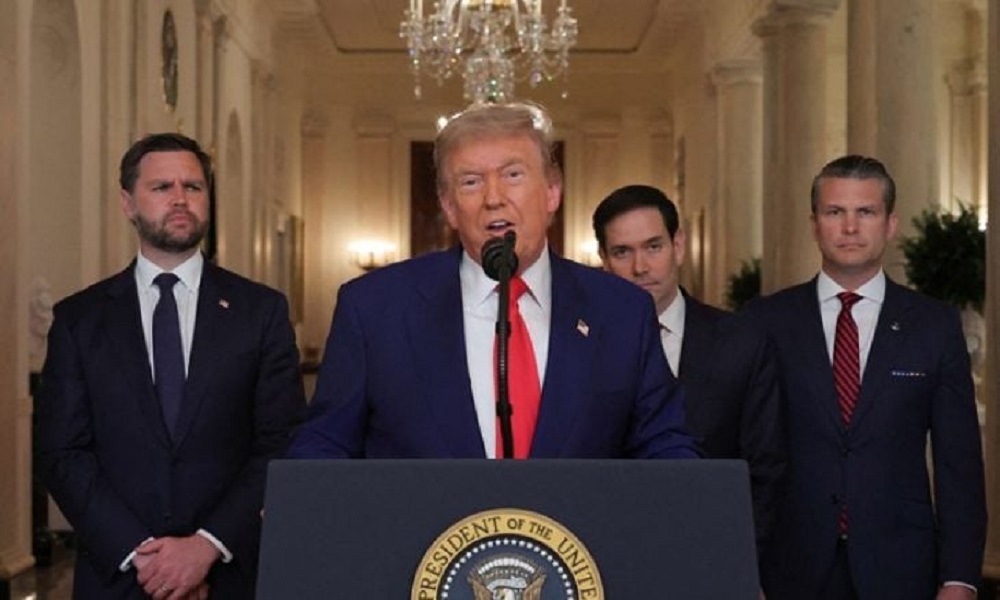
Netanyahu thanked U.S. President Donald Trump for launching a strike that targeted three Iranian nuclear facilities, stating:“We often say: peace through strength. First comes strength, then comes peace. Tonight, President Trump and the United States exercised their full strength.”
He continued:“Your bold decision to strike Iran’s nuclear sites with overwhelming U.S. force will change the course of history. In Operation Rising Lion, Israel achieved remarkable things. But tonight’s operation was unprecedented. The United States did what no other country could.”
Netanyahu claimed:“History will remember that President Trump moved to bring down the world’s most dangerous regime and destroy the world’s most dangerous weapon. His leadership marks a historic turning point that could lead the Middle East and the world toward peace and prosperity.”
He noted that President Trump called him immediately after the operation, and the two leaders exchanged warm congratulations for the success of the mission.
Unified Political Front Calls for More Strikes
Israel’s political leaders, including those in the opposition, urged Washington to continue the strikes on Iran to avoid the danger of a drawn-out war of attrition.
Defense Minister Yisrael Katz echoed this sentiment, congratulating President Trump for his “historic decision” to strike three nuclear sites and prevent Iran from developing a weapon that would have endangered Israel, the region, and U.S. national security.
He also congratulated Netanyahu, crediting him with leading Operation Rising Lion and a decade-long campaign to rally U.S. support against Iran’s nuclear program—calling it a “great and historic achievement.”