
Israel Accused of Extorting Gaza Merchants With $150K Fees Per Truck Amid Starvation Crisis
Massive price hikes, aid blockades, and economic collapse leave Gaza on the brink; Experts call it a military-orchestrated economic war.

Watan-Life in the Gaza Strip has become hostage to Israeli extortion, as the occupation imposes massive fees on trucks carrying goods, allowing certain merchants to bring shipments through in exchange for sums reaching up to 500,000 shekels (about $150,000) per truck.
This comes as Israel continues its policy of selectively allowing goods to enter, banning them entirely from northern Gaza while severely limiting them in the south—part of a broader starvation strategy targeting Gaza’s population.

Despite public optimism about the possibility of a ceasefire agreement, Gazans are suffering from soaring prices. In northern Gaza, Israel is not allowing any aid trucks in. In the south, although limited aid continues to enter, it covers no more than 3% of actual needs—especially after U.S. aid convoys operating in the “Netzarim” area halted several days ago, with current distribution limited to select points in Rafah.
Skyrocketing Prices
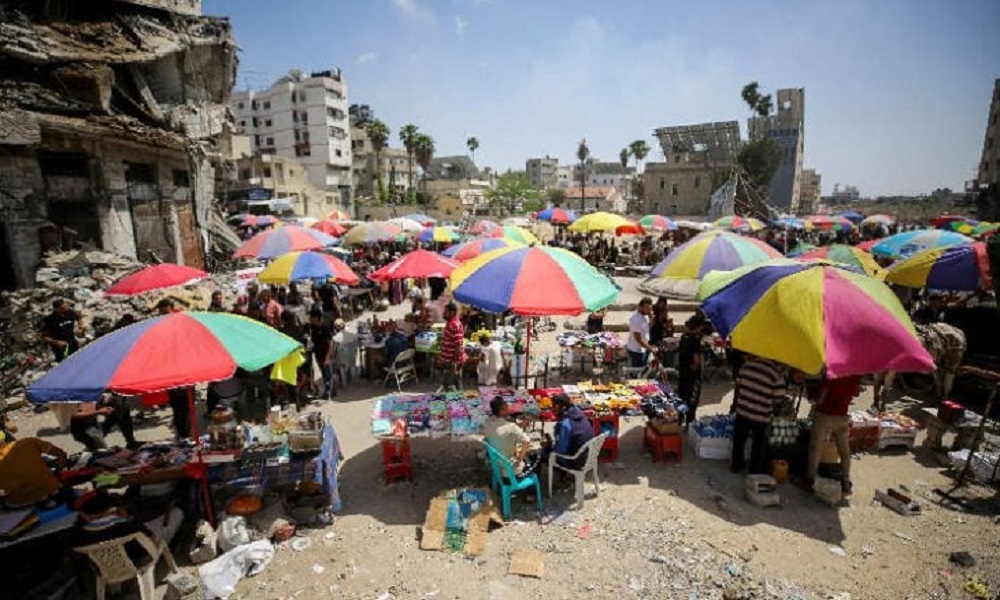
Mahmoud Jouda, a vendor in Sheikh Radwan Market in Gaza City, describes the markets as being in a state of “slow death.” He said:“There’s a severe shortage of goods, and prices have skyrocketed in an insane way. We hoped prices would drop with talk of a ceasefire, but everything has only gotten worse.”
Speaking to Al-Araby Al-Jadeed, Jouda added:“Flour jumped from 25 to 60 shekels in just three days—a 140% increase. Sugar rose from 260 to 320 shekels in the same time. Prices of other scarce goods like cooking oil and vegetables have also surged.” (1 USD ≈ 3.3 shekels)
What’s more alarming is that these spikes are not only daily but compared to pre-war prices: flour has risen by more than 1900%, and sugar by over 10,000%. Israel occasionally allows in limited commercial shipments through special coordination—at exorbitant costs—driving retail prices beyond the reach of most Gazans.
Chaotic Economy
Economic expert Mohammad Barbakh explained that over 95% of Gaza’s population now relies on humanitarian aid as their only source of sustenance due to the ongoing war. Since aid deliveries halted in March, people have entered a state of systematic hunger.
Barbakh told Al-Araby Al-Jadeed:“The occupation has followed a calculated policy—eliminating job opportunities, destroying the economy, then cutting off aid. Even before the siege and starvation, Israel was only letting in about 15% of the usual supply pre-war.”
He added:“This limited flow of goods has caused severe market distortions. Prices are rising hysterically—even several times in one day—with no logical reason. The market is entirely unstable. There’s no way to predict prices or secure basic needs, even for a few days.”
Barbakh also noted that even merchants paying massive coordination fees can no longer ensure regular supplies or fair pricing:“The cost of bringing in goods now exceeds what the market can handle. It’s a deliberate effort to crush any attempt at reviving the local economy.”
Economist Emad Labad described Gaza’s market as “a humanitarian disaster with military-economic planning.” He explained that the occupation has destroyed all means of livelihood, eliminated income-generating opportunities, and pushed unemployment from 45% to 83%, with poverty now affecting over 93% of the population—and potentially soon reaching everyone.
Labad added:“Israel not only blocks goods but also freezes cash flows and external support for humanitarian organizations and the private sector. This has completely paralyzed the economy. The so-called commercial coordination is merely a monopolistic tool to extort merchants and force inflated external pricing.”
“Forcing merchants to pay over 500,000 shekels to bring in a single truck means products will reach consumers at prices they simply can’t afford—especially since more than 80% of families have lost all sources of income.”
He warned that Gaza’s local economy is now at the mercy of what he called “Israeli coordination whims,” with no clear rules or schedules for goods entry—making any form of economic planning, even for relief efforts, nearly impossible.
He concluded:“This is part of an open economic war aimed at breaking the people’s will—not just starving them. What’s needed now is not only aid but also international oversight to ensure its flow and prevent Israel from controlling Gaza’s most basic life requirements.”