Damascus Stock Exchange Relaunched as Private Firm to Signal Syria’s Economic Recovery
Finance Minister says Syria will offer the lowest taxes in the region and aims to attract major investments from Gulf countries
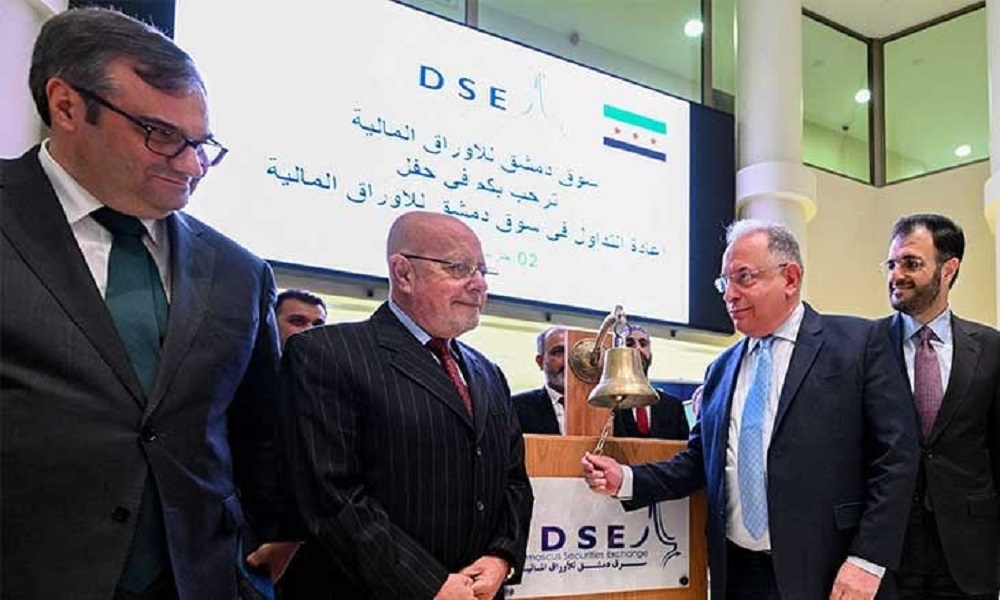
Watan-On Monday morning, Syrian Finance Minister Mohammad Yasar Barnea rang the opening bell of the Damascus Stock Exchange, officially relaunching it as a private company. The move is intended as a signal that “the wheels of the Syrian economy have begun to turn” and that Syria aims to offer the lowest tax rates in the region.
In a formal ceremony attended by members of the transitional Syrian government, business leaders, and economists, trading resumed in Yaafour, a suburb of Damascus, after a six-month suspension. The halt had been implemented to evaluate the operational and financial health of listed companies, address damages and losses, and combat risks of money laundering and fund manipulation.

Minister Barnea said that reopening the exchange is a message of economic revival, with the Damascus Stock Exchange (DSE) rebranded as a private entity and future hub for economic development.
“Our economic vision is rooted in justice, equity, and private sector leadership. We are embracing digital transformation, easing business operations, and unlocking promising investment opportunities,” Barnea said.
Trading will initially be limited to three days a week, following a full regulatory review and implementation of strict compliance measures to ensure transparency and anti-money laundering standards.
In remarks to Al-Watan, Barnea revealed that Syria will now have the lowest tax burden in the region and announced an investment forum mid-June to be attended by Saudi companies and investors, presenting projects in infrastructure, finance, energy, water desalination, agriculture, and industry.
A First Step Toward Economic Revival
Barnea noted that relaunching the exchange without waiting for full legal reforms was necessary to revive market activity and send positive signals, while continuing parallel work on structural modernization.
“We aim to turn Damascus into a functional, modern stock market with thousands of shareholders and foreign investors—not just the modest numbers we have today.”
The government’s plan is to transform the exchange into a center for digital transformation, innovation, small and medium enterprise development, corporate governance, and transitioning family businesses into shareholding companies.
Central Bank Governor Abdelkader Housaria added that the bank will ensure safeguards for serious foreign investment, repatriation of profits, and protection against speculative “hot money.” He emphasized that the DSE will now diversify its offerings to include stocks, bonds, and Islamic instruments (sukuk).
Massive Investments on the Horizon
In comments to Al-Quds Al-Arabi, former head of the Syrian Securities and Financial Markets Commission Abed Fadliyah described the DSE as an emerging market that previously hosted trading for only 28 out of Syria’s 52 public companies.
He said the relaunch represents a first step in reviving Syria’s stalled economy, adding that large-scale investments—especially from Qatar and Saudi Arabia—are already in the pipeline, including $7 billion in recent contracts.
Fadliyah said that for real growth, production must resume, currently stalled due to weak consumption caused by low income levels. He expressed optimism that the economy would rebound soon, especially if Western sanctions are fully lifted and Syria rejoins the SWIFT banking network.
He noted that while stock trading in Syria was technically open to foreigners, participation was almost exclusively Syrian. However, expected increases in listed companies and foreign interest could finally open the exchange to international markets.
During the Assad regime, no foreign investors actively participated in DSE trading, despite the listing of joint Arab and foreign-owned firms like Fransabank, Emirates Insurance, Syrian-Kuwaiti Insurance, Bank Al-Sham, Al Baraka Syria, and Cement Al-Badia, as well as telecom giants Syriatel and MTN.
On the relisting of Syriatel and MTN, which have been under judicial guardianship since before the fall of the previous regime, Fadliyah clarified that the state does not own the shares, though it has de facto control, with state-appointed monitors working within company management. He noted trading in their stocks has remained minimal due to their unusual legal status.
He dismissed allegations that the recent six-month suspension of the exchange was related to money laundering controls, explaining that trading volume was historically low, and such activities were virtually absent from the market.