U.S.-Gulf Summit in Riyadh: Calls for Ending Gaza War and Supporting Syria Dominate Discussions
Leaders at the Gulf-U.S. summit stress the need for a comprehensive solution to the Palestinian issue and support for Syria’s sovereignty and security.
Watan-The demands to end the Israeli war on Gaza and support Syria dominated the words of Gulf leaders at the U.S.-Gulf summit held on Wednesday in Riyadh.
The summit was attended by Qatar’s Emir Tamim bin Hamad Al Thani, Kuwait’s Emir Mishal Al-Ahmad Al-Jaber Al-Sabah, Bahrain’s King Hamad bin Isa Al Khalifa, Abu Dhabi’s Crown Prince Khaled bin Mohammed bin Zayed Al Nahyan, and Oman’s Deputy Prime Minister Asaad bin Tariq Al Said.


U.S. President Donald Trump arrived in Saudi Arabia on Tuesday, kicking off his first Middle East tour during his second presidential term, which includes stops in Qatar and the UAE.
This summit is the fifth between the United States and the Gulf Cooperation Council (GCC) countries, following four previous ones: the first in Camp David in May 2015, the second in April 2016, the third in May 2017 in Riyadh with Trump during his first term, and the fourth in Jeddah in July 2022, which also included leaders from Egypt, Jordan, and Iraq.
Ending the Gaza War and Supporting Syria
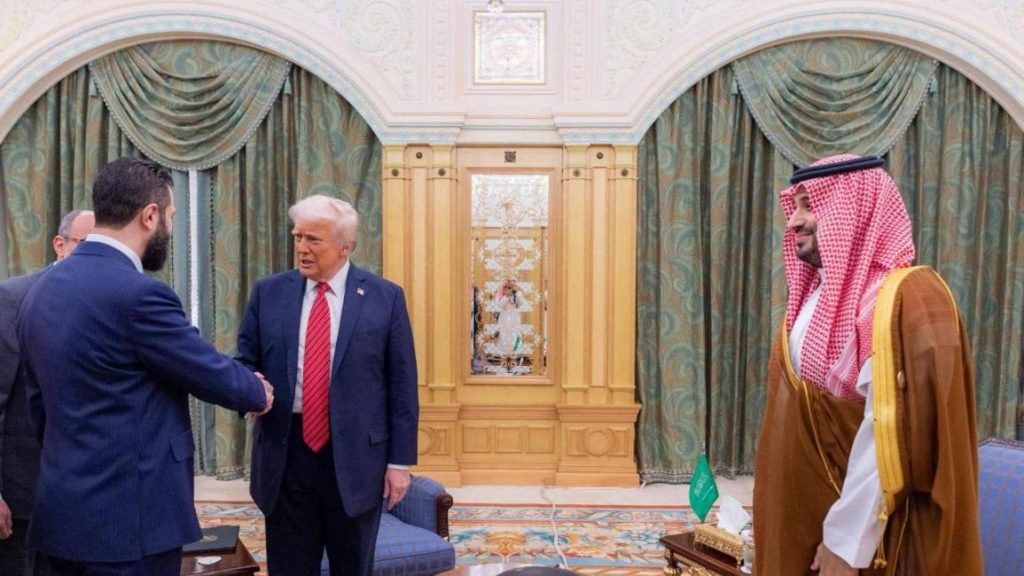
In his opening speech, Saudi Crown Prince Mohammed bin Salman emphasized that the summit comes as an extension of the strategic relationship between the United States and Saudi Arabia, reflecting “Riyadh’s keenness to work collectively to enhance and develop our relations to meet the aspirations of the people of both countries.”
He confirmed that Saudi Arabia “is cooperating with the United States to halt the escalation in Gaza, end the war, and find a comprehensive solution to the Palestinian issue.”
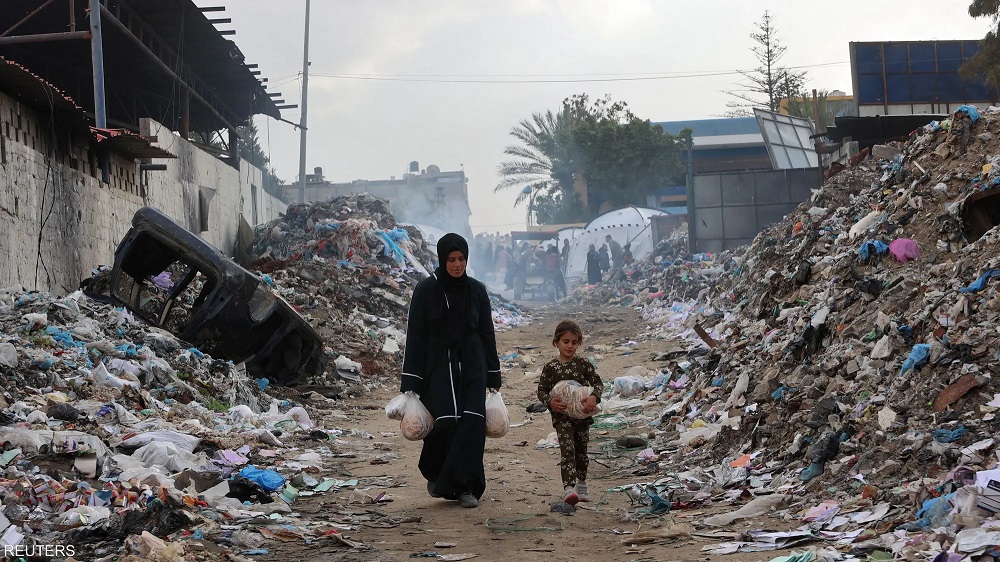
With U.S. support, Israel has been committing genocide in Gaza since October 7, 2023, resulting in over 172,000 Palestinian martyrs and injured, mostly women and children, with more than 11,000 missing.
Bin Salman added, “We reaffirm our respect for Syria’s sovereignty and support the efforts of the government to achieve security. We commend President Trump’s decision to remove sanctions on Syria, which will ease the suffering of the Syrian people.”
He emphasized that “the Kingdom encourages dialogue between the Yemeni parties and aims for a comprehensive political solution,” stressing “Saudi Arabia’s continued efforts to end the crisis in Sudan through the Jeddah platform, which enjoys Saudi and American sponsorship.”
He also stressed “the importance of preserving Lebanon’s sovereignty, its security, and reforming its institutions, and restricting arms to the state.” Bin Salman welcomed the “ceasefire between India and Pakistan and hopes that it will help contain escalation and restore calm.”
He emphasized “Saudi Arabia’s readiness to reach a political solution to end the Ukrainian crisis.”
Kuwaiti Emir Sheikh Nawaf Al-Ahmad Al-Jaber Al-Sabah noted that “today’s meeting is taking place amidst delicate international circumstances, marked by escalating crises and non-traditional challenges that exceed national borders. The GCC countries have demonstrated unity in supporting the security and stability of the region.”
He stressed Kuwait’s firm commitment to enhancing humanitarian and relief efforts in areas of conflict and disaster, calling for “coordinating Gulf-American developmental aid to ensure an effective and sustainable response to the needs of affected communities.”
The Emir emphasized the importance of enhancing international efforts to ensure Syria’s security and stability, safeguard its sovereignty, and end the suffering of its people, as well as to halt foreign interference in its affairs. He expressed appreciation for Trump’s decision to lift sanctions on Syria.
He also expressed appreciation for U.S. efforts to resolve international disputes, including the ceasefire between India and Pakistan and efforts to end the Russia-Ukraine war.
Two-State Solution
In his speech, Bahrain’s King Hamad bin Isa Al Khalifa said that Trump’s participation in the summit underscores “the depth and enduring importance of the strategic partnership between the GCC countries and the United States.”
He added, “We greatly appreciate President Trump’s effective diplomatic efforts toward achieving peace and stability in the Middle East and the world. We thank him for his decision to lift economic sanctions on Syria and look forward to further cooperation to create a safe, stable, and prosperous region that includes all its countries.”
King Hamad noted, “This wise policy represents a unique opportunity to move forward together toward establishing a just and lasting peace, ensuring the rights of the Palestinian people through a two-state solution, preserving regional security and stability, and contributing to a weapons of mass destruction-free region, preventing an arms race.”
He affirmed that “the success of ongoing negotiations between the United States and Iran will enhance stability and raise prosperity levels for the region’s countries, and we greatly appreciate these efforts.”
Commendations
Oman’s Deputy Prime Minister Asaad bin Tariq Al Said, in his speech at the summit, stated that “Gulf-U.S. relations are long-standing strategic ties aimed at establishing security, stability, and prosperity.”
He explained that “the partnership is reflected in the shared commitment to achieving integration and mutual dependence in political, economic, technological, and defense interests, and cooperating to solve regional and international crises and challenges.”
Bin Tariq added, “We express our grave concern over the humanitarian crisis in Gaza, caused by decades of Israel’s illegal occupation of Palestinian lands.”
He continued, “This ongoing injustice, along with the international community’s failure to achieve a just peace, is at the heart of many regional challenges.”
He also noted, “We have witnessed historic steps toward peace and stability, and we appreciate President Trump’s constructive role in ending the Yemen conflict and restoring safe navigation in the Red Sea, paving the way for further success in the Yemeni file, achieving lasting peace and prosperity for this ancient Arab country.”
Bin Tariq, who hosts mediation efforts between Iran and the U.S., stated that “the realism and mutual respect shown in the ongoing dialogue between the United States and the Islamic Republic of Iran regarding nuclear non-proliferation efforts inspire confidence in the possibility of reaching a practical, honorable, and sustainable agreement between the two sides.”
He clarified that “the diplomatic strategic policy pursued by President Trump’s administration, which prefers dialogue and deal-making over escalation and confrontation, is a model approach that we welcome. By involving all parties and challenging outdated theories, the U.S. has opened a practical path toward real positive change.”
Bin Tariq stressed that “comprehensive peace, permanent security, and desired prosperity for all cannot be achieved except through the establishment of an independent Palestinian state, where Palestinians and Israelis live with dignity, exercise sovereignty over their borders, and build thriving, proud nations.”
He expressed “hope for continued global leadership from President Trump’s administration to resolve this long-standing conflict, which has cast a shadow over our region for so long.”
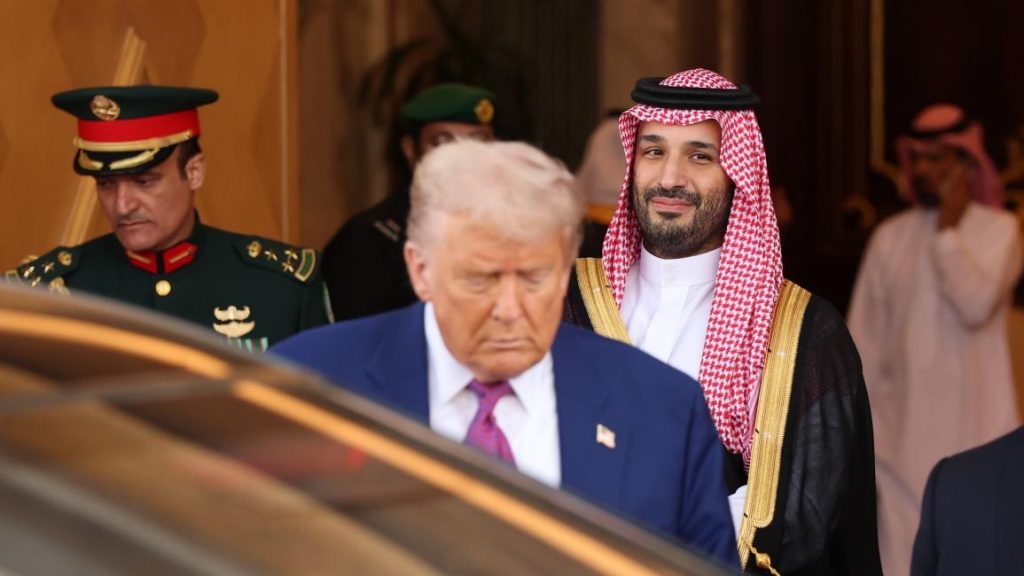
Following the summit, Trump departed Riyadh for Doha, where he was warmly bid farewell by Saudi Crown Prince Mohammed bin Salman.
Trump had previously visited Saudi Arabia during his first term in 2017, meeting with King Salman bin Abdulaziz and participating in a summit in Riyadh.
This visit marks Trump’s first in his second term, part of his first Middle East tour since being re-elected as president in January, with the tour continuing until Friday and including Qatar and the UAE, according to a statement from the U.S. State Department.